At present in Bandhavgarh this grass is flowering every where.Thysanolaena maxima is used by villagers to make broom, phool jhhadu.
Thursday, December 22, 2016

Friday, December 9, 2016
Bandhavgarh revival
Bandhavgarh is under revival. New Field Director is working day and night to get the things right.
Park is in such a mess that even he work for three years solid even then he will be able to see only ten percent results of his hard work here.
Park is in such a mess that even he work for three years solid even then he will be able to see only ten percent results of his hard work here.
Thursday, November 24, 2016
Bandhavgarh
This can be a controversial post only because either you have not read enough or you don't have the knowledge about the jungle and it's dwellers.
I asked this question to many that when tiger density rises in an specific area such as National Park then is it not important that the herbivore population should also increase in that ratio to sustain the ecological balance?
Second question I asked Why we do not see Spotted Deer rut in March?
Why all of a sudden burning of Grassland and Fireline has become a taboo in Forest Management in the Parks when present Parks thrived on this practice only so far?
Capt Forsyth mentions grass burning in jan feb in his book in The Highlands of Central India published in 1889.
George B Schaller mentions meadow burning in Kanha in Jan - burning of the grasses in january, chital and barasingha congregated on the meadows and remained readily observable until August. He writes - Since the cool season follows the retreat of the monsoon, the vegetation is still green and rank in the forest , but the grasses on the meadows have already gone to seed and turned yellow. The forest department then begins to burn the grass on the kanha meadow burning a patch here, another there until after a month or more only a black stubble remains. In 1963 the burning began on December 28 but in 1964 as early as November 30. Burning the grass apparently releases nutrients into the soil and, together with the sporadic shower / heavy dew stimulates a fresh growth of green grass to appear within two weeks. The new growth is very sparse in areas that are not burned. (George Schaller)
The Kanha meadow was burned by Danbar Brander (1923) in 1902 and has probably been set afire every year since then. ()
It means when Indian Foresters got Kanha in their hands it was a good habitat for all the herbivores then why and when it got worst that grasses were sown to get better fodder for deer.
This is the time when early rut in March and April was recorded depending on the burning of meadows (Danbar Brander) while major rut was always recorded within first fortnight of monsoon rains. (Mr H S Panwar)
Early 1980's within a fortnight of monsoon rains as many as 5000 Spotted Deer were recorded in Kanha meadow. While normal numbers throughout the season were about 3000. (Mr H S Panwar)
This is the time when Mr Panwar left Kanha who used meadow burning practice since the day he arrived there as Director till the day he left for Project Tiger in delhi.
Danbar Brander writes - There is a distinct rut in the end of April and the beginning of May, when most of the breeding takes place, and during this period it is rare indeed for a fully mature animal not to be in full horn.
Mr Hemendra Singh Panwar writes in Kanha National Park guide book - In Kanha fire is used as a tool . The exact words of Sh Panwar are However the popular axiom "Fire is a bad master but a good servant" stands well for wildlife management too. Controlled and periodic winter firing of grasslands help suppresses advance of woodland and produces green shoots in winter for animals to graze.
Although he warns that if this practice is not used wisely then it may deteriorate the productivity and fodder quality.
We have seen alternate meadow burning in Kanha and that did not deteriorate the quality till early 90's. (as i saw that place)
If we see the same measures took place in Bandhavgarh then Bandhavgarh started its history as National Park with Zero Deer and Zero Tiger.
When all the villages were shifted from the park area those farmlands turned into a good grassland. (Mr J J Dutta)
Surplus population of Deer from surrounding area of a Hunting game reserve started moving in newly declared National Park which did not had any kind of disturbance for wild animals.
Wildlife managers who came here learn their a b c d of wildlife management in Kanha so they also kept on doing the practice of wildlife management what they saw / learn in Kanha and one of them was burning of grasslands and fireline.(Mr J J Dutta)
Winter burning of grasslands in Bandhavgarh did not harm any rhizome of any grass species because in December / January the lower stem of grasses are still green so what all fire did was removed the seedy grass that deer don't like and gave some more nutrition to land to grow more new shoots from the same rhizome. (Mr J J Dutta)
This attracts deer in grassland to feed on new shoots and this congregation of deer ultimately starts rut in early summer months. This depends on burning of grass meadows time in winter, if they are burnt in Nov - Dec the rut starts in March and if grasslands burnt later then in April.
This rut is very important for deer population or for keeping the balance right of prey base for tigers.
I asked this question to many that when tiger density rises in an specific area such as National Park then is it not important that the herbivore population should also increase in that ratio to sustain the ecological balance?
Second question I asked Why we do not see Spotted Deer rut in March?
Why all of a sudden burning of Grassland and Fireline has become a taboo in Forest Management in the Parks when present Parks thrived on this practice only so far?
Capt Forsyth mentions grass burning in jan feb in his book in The Highlands of Central India published in 1889.
George B Schaller mentions meadow burning in Kanha in Jan - burning of the grasses in january, chital and barasingha congregated on the meadows and remained readily observable until August. He writes - Since the cool season follows the retreat of the monsoon, the vegetation is still green and rank in the forest , but the grasses on the meadows have already gone to seed and turned yellow. The forest department then begins to burn the grass on the kanha meadow burning a patch here, another there until after a month or more only a black stubble remains. In 1963 the burning began on December 28 but in 1964 as early as November 30. Burning the grass apparently releases nutrients into the soil and, together with the sporadic shower / heavy dew stimulates a fresh growth of green grass to appear within two weeks. The new growth is very sparse in areas that are not burned. (George Schaller)
The Kanha meadow was burned by Danbar Brander (1923) in 1902 and has probably been set afire every year since then. ()
It means when Indian Foresters got Kanha in their hands it was a good habitat for all the herbivores then why and when it got worst that grasses were sown to get better fodder for deer.
This is the time when early rut in March and April was recorded depending on the burning of meadows (Danbar Brander) while major rut was always recorded within first fortnight of monsoon rains. (Mr H S Panwar)
Early 1980's within a fortnight of monsoon rains as many as 5000 Spotted Deer were recorded in Kanha meadow. While normal numbers throughout the season were about 3000. (Mr H S Panwar)
This is the time when Mr Panwar left Kanha who used meadow burning practice since the day he arrived there as Director till the day he left for Project Tiger in delhi.
Danbar Brander writes - There is a distinct rut in the end of April and the beginning of May, when most of the breeding takes place, and during this period it is rare indeed for a fully mature animal not to be in full horn.
Mr Hemendra Singh Panwar writes in Kanha National Park guide book - In Kanha fire is used as a tool . The exact words of Sh Panwar are However the popular axiom "Fire is a bad master but a good servant" stands well for wildlife management too. Controlled and periodic winter firing of grasslands help suppresses advance of woodland and produces green shoots in winter for animals to graze.
Although he warns that if this practice is not used wisely then it may deteriorate the productivity and fodder quality.
We have seen alternate meadow burning in Kanha and that did not deteriorate the quality till early 90's. (as i saw that place)
If we see the same measures took place in Bandhavgarh then Bandhavgarh started its history as National Park with Zero Deer and Zero Tiger.
When all the villages were shifted from the park area those farmlands turned into a good grassland. (Mr J J Dutta)
Surplus population of Deer from surrounding area of a Hunting game reserve started moving in newly declared National Park which did not had any kind of disturbance for wild animals.
Wildlife managers who came here learn their a b c d of wildlife management in Kanha so they also kept on doing the practice of wildlife management what they saw / learn in Kanha and one of them was burning of grasslands and fireline.(Mr J J Dutta)
Winter burning of grasslands in Bandhavgarh did not harm any rhizome of any grass species because in December / January the lower stem of grasses are still green so what all fire did was removed the seedy grass that deer don't like and gave some more nutrition to land to grow more new shoots from the same rhizome. (Mr J J Dutta)
This attracts deer in grassland to feed on new shoots and this congregation of deer ultimately starts rut in early summer months. This depends on burning of grass meadows time in winter, if they are burnt in Nov - Dec the rut starts in March and if grasslands burnt later then in April.
This rut is very important for deer population or for keeping the balance right of prey base for tigers.
Tuesday, October 11, 2016
Preying mantis eating common lime butterfly
Bandhavgarh 1997.
Praying mantis eating common lime butterfly.
In those days I was using Nikon N 90 body but did not had any macro lens so we use to use use those macro ring on normal lens and were very happy with results.
Skay's camp garden was full of flowers and Butterfly larval plants in those days. Later on the fruit trees grown and birds taken over the garden.

Bandhavgarh in 1988
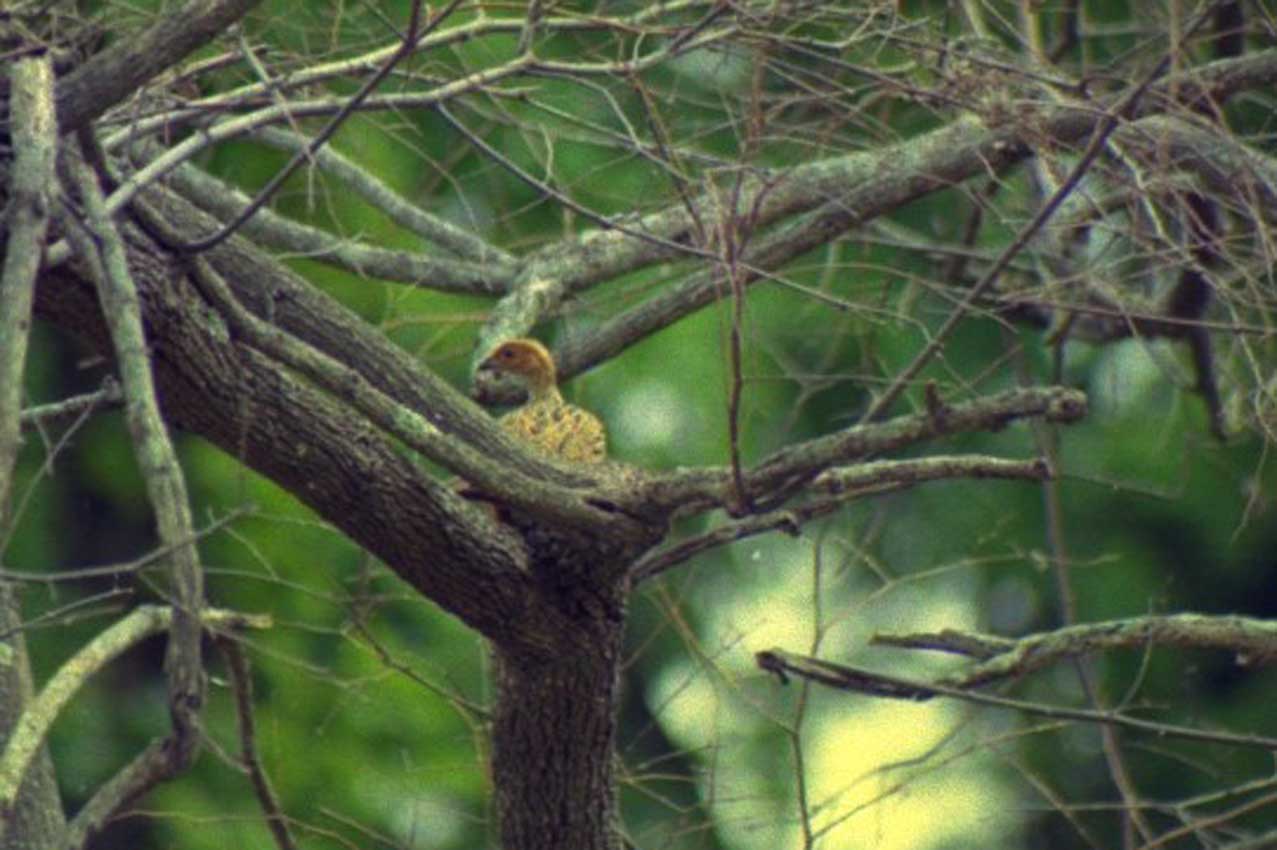
Bandhavgarh, some time in 1988. Park was only 20 years old. Most of the land in Tala Range still showed sign of villagers land. Rice field bunds were still visible. Most of the waterholes were filled by natural springs.
Bird life was good. This was the time when we use to see "Tree Duck" nest in the park.
I had a Pentax MX camera body with 80-200 F 4 - 5.6 lens.
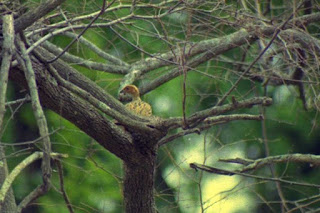
Bird life was good. This was the time when we use to see "Tree Duck" nest in the park.
I had a Pentax MX camera body with 80-200 F 4 - 5.6 lens.
Monday, July 18, 2016
Babu killing Jungle Cat
In Jan 2002 Pyari's first litter sub adult cubs were still roaming in their mothers territory and diminishing her prey base in Chakradhara meadow.
One morning we saw Narangi, female cub, sniffing in tall grass. We followed her for 10 minutes or so and saw her cornering something under a dead tree.
At that point me and Kuttappan were not sure about the animal she cornered so we decided to stop far far away from them.
Narangi lowered her head and moved closer towards the log where this animal was hiding.
Suddenly we saw Narangi leaping back and started licking her nose.
She was scratched on her nose by a Jungle cat.
Her brother was watching her. When he realised that she is not going to hunt that then he came forward saw the cat and killed her instantly.
Those were the film days.
I was very cautiously using my camera.


Watching whole incident through the view finder.
At last he just showed the cat behaviour of a kitten.
Tossing his kill in air.
Sorry for poor scan
Manglu 2
So after the photo session and meeting of his Mem Saab to my Mem Saab he started showing us the wound mark of leopard canines which he got somewhere near Chhatarpur.
A leopard was creating lot of trouble for villagers by attacking their livestock and keeping them shut in their houses during dark hours. Manglu said that such was the fear of the leopard that women and children were not allowed to go out and were allowed to pee and poo in the house compound.
At last a rescue team from Kanha was sent to deal with the leopard and decision was made to capture him alive.
Unofficially Manglu was Head of the Team because he has to chose the spot to put the cage and he himself has to set the cage and check it.
So one afternoon Manglu set the trap in that cage and while he was going to check it the Leopard strike. He charged him from the back and Manglu could feel his canine going deeper and deeper on his neck and cheek.
Manglu said I thought within minutes he is going to kill me so I must do something. I slipped my right arm over his paw and started strangling him with my both hands.
I knew I must press it hard so I pressed at the right spot and within seconds I could feel that his canine grip on my neck is going lose.
I saw my chance and pressed it more hard.
Now he withdrew his canine completely from the first grip here I thought probably he is going to bite me at another spot so I pressed it more hard.
Now I can feel his weight on my hands.
His forearms started drooping.
God knows from where I got the courage and power that I decided to press it more harder.
Now me and Leopard are standing face to face. He is of the same height as me.
I had no pain but I knew he did put his canine on my face because I can feel something dribbling to my neck.
I am holding Leopards neck and I can feel his total body weight in my hands too. His eyes are turning white. He is no longer looking at me. Saliva dripping and his tongue hanging on one side of his mouth.
Now I thought I have killed him so I threw him like a bag (the word he used was jhola) on one side and ran for the safety.
I spent a month in Hospital and Leopard must have learnt his lesson that day, Never go close to human.
We all had a big laugh when I asked him that they never let you drink Mahua in Hospital.
I photographed Manglu again and as usual shook hands with him before leaving.
A leopard was creating lot of trouble for villagers by attacking their livestock and keeping them shut in their houses during dark hours. Manglu said that such was the fear of the leopard that women and children were not allowed to go out and were allowed to pee and poo in the house compound.
At last a rescue team from Kanha was sent to deal with the leopard and decision was made to capture him alive.
Unofficially Manglu was Head of the Team because he has to chose the spot to put the cage and he himself has to set the cage and check it.
So one afternoon Manglu set the trap in that cage and while he was going to check it the Leopard strike. He charged him from the back and Manglu could feel his canine going deeper and deeper on his neck and cheek.
Manglu said I thought within minutes he is going to kill me so I must do something. I slipped my right arm over his paw and started strangling him with my both hands.
I knew I must press it hard so I pressed at the right spot and within seconds I could feel that his canine grip on my neck is going lose.
I saw my chance and pressed it more hard.
Now he withdrew his canine completely from the first grip here I thought probably he is going to bite me at another spot so I pressed it more hard.
Now I can feel his weight on my hands.
His forearms started drooping.
God knows from where I got the courage and power that I decided to press it more harder.
Now me and Leopard are standing face to face. He is of the same height as me.
I had no pain but I knew he did put his canine on my face because I can feel something dribbling to my neck.
I am holding Leopards neck and I can feel his total body weight in my hands too. His eyes are turning white. He is no longer looking at me. Saliva dripping and his tongue hanging on one side of his mouth.
Now I thought I have killed him so I threw him like a bag (the word he used was jhola) on one side and ran for the safety.
I spent a month in Hospital and Leopard must have learnt his lesson that day, Never go close to human.
We all had a big laugh when I asked him that they never let you drink Mahua in Hospital.
I photographed Manglu again and as usual shook hands with him before leaving.
Subscribe to:
Posts (Atom)